Wednesday, August 25, 2010

Antivirdial.com removal guide

Don't Copy From This Blog...

Protected by Copyscape Plagiarism Detection
Antivirdial.com is yet another Security Suite's landing page. As you probably already know, Security Suite is a fake anti-virus program that pretends to scan your computer for malware. It reports false system security threats and prompts to pay for a full version of the program to remove the threats. This is a very common tactic used by nearly all rogue anti-virus or anti-spyware programs. Antivirdial.com is not the first website that promotes this rogue program. Previously, we posted about strongantivir.com, antivirzet.com and some other malicious websites related to Security Suite malware. Antivirdial.com uses the same web template as all the other rogue landing pages. It also provides false information about the rogue product and false testimonials from people who supposedly bought Security Suite.

If you find that your computer is infected with Security Suite or Antivirdial.com browser hijacker then please follow Security Suite removal guide to remove the rogue program and any additional malware from your computer for free. Good luck and be safe online!

Screen shot of antivirdial.com:


Share this information with other people:

Sunday, August 22, 2010

Remove the fake Microsoft Security Essentials Alert (Uninstall Instructions)

Don't Copy From This Blog...

Protected by Copyscape Plagiarism Detection
The fake Microsoft Security Essentials Alert is a piece of malware that gives exaggerated or false threat reports on the compromised computer. It attempts to convice you that your computer is infected and offer a free download to scan for malware. This malware impersonates the legitimate Microsoft Security Essentials anti-virus application. It's not the first time when malware authors abuses regular software names. Once installed, this fake Microsoft Security Essentials Alert will claim that your computer is infected with Unknown Win32/Trojan. Then it will state that it was unable to remove the infection and that you should run Online Scan to remove the threat. Eventually it will list 35 different anti-virus programs, but only five of them will supposedly detect the virus on your computer. And guess what? All those five anti-virus programs are fake:
  • Red Cross Antivirus
  • Peak Protection 2010
  • Pest Detector 4.1
  • Major Defense Kit
  • AntiSpy Safeguard


Red Cross Antivirus


Peak Protection 2010


Pest Detector 4.1


Major Defense Kit


AntiSpy Safeguard


(Thanks to rogueamp for making this video)

Other anti-virus programs in that list are perfectly legitimate: NOD32, Kaspersky, Panda, Symantec, Trend Micro and etc. If you click on Free Install button you will install a rogue anti-virus program on your computer. It could be Red Cross Antivirus, Peak Protection 2010, Pest Detector 4.1, Major Defense Kit or AntiSpy Safeguard. Basically, it's only one fake anti-virus program with five different names and graphical user interfaces. While the installed scareware is running, it will scan your computer for malware again. Finally, it will prompt you to pay for a full version of the program to remove the infections. Furthermore, it will block nearly all legitimate programs on your computer and display the following message:
The application taskmgr.exe was launched successfully but it was forced to shut down due to security reasons.This happened because the application was infected by a malicious program which might pose a threat for the OS.
It is highly recommended to install the necessary heuristic module and perform a full scan of your computer to exterminate malicious programs from it.


It will disable Task Manager, Registry Editor and other useful system tools as well. The fake Microsoft Security Essentials Alert and related rogue program will display fake security warnings and pop-ups from Windows task bar like every one or two minutes. Some of those fake alerts will state:
Warning! Database updated failed!
Database update failed!
Outdated viruses database are not effective can't guarantee adequate protection and security for your PC! Click here to get the full version of the product and update the database!


Without a doubt, the fake Microsoft Security Essentials Alert is nothing more but a scam. Don't fall victims to these attacks and do not install Red Cross Antivirus, Peak Protection 2010, Pest Detector 4.1, Major Defense Kit or AntiSpy Safeguard on your computer. Obviously, you shouldn't pay to register the fake AVs. If you have already bought any of those fake anti-virus programs then please contact your credit card company and dispute the charges. Then please follow the removal instructions below to remove the fake Microsoft Security Essentials Alert and related rogue programs from your computer for free using legitimate anti-malware programs. Please follow the removal guide below. Last, but not least, if you have any questions or additional information about this virus please don't hesitate and leave a comment. Good luck and be safe online!


Fake Microsoft Security Essentials Alert removal instructions (using HijackThis):

1. Download iexplore.exe (NOTE: iexplore.exe file is renamed HijackThis tool from TrendMicro).
Launch the iexplore.exe and click "Do a system scan only" button.
If you can't open iexplore.exe file then download explorer.scr and run it.

2. Search for these entries in the scan results:
O4 - HKCU\..\Run: [tmp] %UserProfile%\Application Data\hotfix.exe
O4 - HKCU\..\RunOnce: [SelfdelNT] cmd /C del "%UserProfile%\Desktop\antispy.exe"
Select all these entries and click once on the "Fix checked" button. Close HijackThis tool.

3. Download anti-malware program from the list below and run a quick system scan.
NOTE: before saving the selected program onto your computer, please rename the installer to iexplore.exe or winlogon.exe. With all of these tools, if running Windows 7 or Vista they MUST be run as administrator. Launch the program and follow the prompts. Don't forget to update the installed program before scanning.

4. New threats appear every day. In order to protect your PC from such (new) infections we strongly recommend you to use ESET Smart Security.


Fake Microsoft Security Essentials Alert removal instructions (in Safe Mode with Networking):

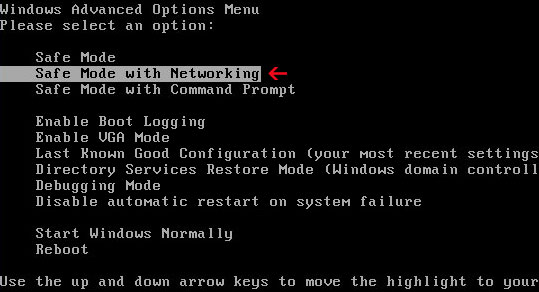
1. Reboot your computer is "Safe Mode with Networking". As the computer is booting tap the "F8 key" continuously which should bring up the "Windows Advanced Options Menu" as shown below. Use your arrow keys to move to "Safe Mode with Networking" and press Enter key. Read more detailed instructions here: http://www.computerhope.com/issues/chsafe.htm


NOTE: Login as the same user you were previously logged in with in the normal Windows mode.

2. Download free anti-malware software from the list below and run a full system scan.
NOTE: before saving the selected program onto your computer, please rename the installer to iexplore.exe or winlogon.exe. With all of these tools, if running Windows 7 or Vista they MUST be run as administrator. Launch the program and follow the prompts. Don't forget to update the installed program before scanning.

3. New threats appear every day. In order to protect your PC from such (new) infections we strongly recommend you to use ESET Smart Security.


Fake Microsoft Security Essentials Alert associated files and registry values:

Files:

For Windows XP users:
  • C:\Documents and Settings\UserName\Application Data\PAV\
  • C:\Documents and Settings\UserName\Application Data\hotfix.exe
  • C:\Documents and Settings\UserName\Application Data\antispy.exe
  • C:\Documents and Settings\UserName\Application Data\defender.exe
  • C:\Documents and Settings\UserName\Application Data\tmp.exe
  • C:\Documents and Settings\UserName\Local Settings\Temp\kjkkklklj.bat
For Windows Vista and Windows 7 users:
  • C:\Users\UserName\Application Data\PAV\
  • C:\Documents and Settings\UserName\Application Data\hotfix.exe
  • C:\Users\UserName\Application Data\antispy.exe
  • C:\Users\UserName\Application Data\defender.exe
  • C:\Users\UserName\Application Data\tmp.exe
  • C:\Users\UserName\Local Settings\Temp\kjkkklklj.bat
Registry values:
  • HKEY_CURRENT_USER\Software\PAV
  • HKEY_CURRENT_USER\Software\Microsoft\Windows\CurrentVersion\Internet Settings "WarnonBadCertRecving" = "0"
  • HKEY_CURRENT_USER\Software\Microsoft\Windows\CurrentVersion\Internet Settings "WarnOnPostRedirect" = "0"
  • HKEY_CURRENT_USER\Software\Microsoft\Windows\CurrentVersion\Run "tmp"
  • HKEY_CURRENT_USER\Software\Microsoft\Windows\CurrentVersion\RunOnce "SelfdelNT"
  • HKEY_CURRENT_USER\Software\Microsoft\Windows NT\CurrentVersion\Winlogon "Shell" = "%UserProfile%\Application Data\antispy.exe"
Share this information with other people:

Saturday, August 21, 2010

Remove Advanced Security Tool 2010 (Uninstall Instructions)

Don't Copy From This Blog...

Protected by Copyscape Plagiarism Detection
Advanced Security Tool 2010 is a fake anti-virus program that masquerades as a legitimate security product. It attempts to convince users that their computers are infected with spyware, adware, Trojan horses and other malicious software. Once this fake program is installed it will pretend to scan your computer and claim to find infected files. Advanced Security Tool 2010 will report false or grossly exaggerated system security threats and infected files which may not even exist on your PC. Then it will prompt you to pay for a full version of the program to seemingly remove found malware. This program is nothing more but a scam. It won't remove any infections and it won't protect your computer against viruses. Thankfully we've got the instructions to help you to remove Advanced Security Tool 2010 from your computer for free using legitimate anti-malware programs. Please follow our removal instructions below.


AdvancedSecurityTool2010 is a clone of Security Central malware. It's promoted through the use of Trojans, fake online scanners and other malicious websites that either distribute fake software or use exploits to enter the computer's operating system without your permission or knowledge. Advanced Security Tool 2010 may compromis windows registry keys in an attempt to disable the Safe Mode. In such case you won't be able to reboot your computer in Safe Mode and Safe Mode with Networking. You will have to end the Advanced Security Tool's processes and download malware removal tool to remove the rogue program and any related malware from your computer. Advanced Security Tool 2010 also creates a startup registry entry so that it will start automatically when Windows loads. Furthermore, this scareware may register its Internet Explorer plug-in module called BrcWiz Class which is of course not digitally signed by Microsoft. The malicious module (BHO) will redirect you to entirely unrelated websites. If you use Internet Explorer then you may have to disable that module. The rogue program doesn't affect other browsers, so if you have one then go ahead an use it.


(Thanks to rogueamp for making this video)

As a typical fake anti-virus program, Advanced Security Tool 2010 will display fake security warnings and pop-ups about various infections and attacks from the Internet. The text of those alerts are:
WARNING! Advanced Security Tool has found [number] useless and UNWANTED files on your computer!
Firewall Warning
Hidden file transfer to remote host was detected
Advanced Security Tool 2010 has detected that somebody is trying to transfer your private data via Internet. We strongly recommend you to block the attack immediately.

Privacy Alert
Your system was found to be infected with itercepting programs. These can log your activity and damage your privacy. Click here for Advanced Security Tool 2010 spyware removal.


As you can see, Advanced Security Tool 2010 uses various misleading methods to scare you into purchasing the program. It's not the program you would like to have on your computer. You should uninstall it upon detection. Also, note that this fake anti-virus program can download or request other malware from the Internet. Most importantly, don't purchase it! If you have already purchased this rogue program then please contact your credit card company immediately and dispute the charges. Then follow the removal instructions below to remove Advanced Security Tool 2010 from your computer for free. Last, but not least, after you remove the rogue program from the system you should also purge all old system restore points and create a new one. If you don't know how to delete system restore points then please follow the steps in the Microsoft knowledgebase article http://support.microsoft.com/kb/310405. If you have any questions or additional information about this virus please leave a comment. Good luck and be safe online!


Advanced Security Tool 2010 removal instructions:

NOTE: if you can use Internet Explorer without any problems then proceed to step #3. This also applies for those of you who use other web browsers (Mozilla Firefox, Chrome, Opera).

1. Open up Internet Explorer. Go to Tools -> Internet Options. Then open "Programs" tab and click on "Manage add-ons" button at the buttom of the window. Manage Add-ons window will show up.
2. Search for "BrcWiz Class" add-on and disable or remove it. Then close the window and click OK to save the changes.
3. Download iexplore.exe (NOTE: iexplore.exe file is renamed HijackThis tool from TrendMicro).
Launch the iexplore.exe and click "Do a system scan only" button.
If you can't open iexplore.exe file then download explorer.scr and run it.

4. Search for similar entries in the scan results:
F2 - REG:system.ini: Shell=explorer.exe C:\WINDOWS\system32\ntload.exe
O2 - BHO: BrcWiz Class - {80c10400-59cb-4c79-97ce-cc693103afca} - %UserProfile%\Application Data\scan.dll
O4 - HKLM\..\Run: [rundll32] C:\WINDOWS\system32\ntload.exe
O4 - HKCU\..\Run: [rundll32] %UserProfile%\rundll32.exe
O4 - HKCU\..\Run: [AdvSecTool] "%UserProfile%\Application Data\asectool.exe

Select all similar entries and click once on the "Fix checked" button. Close HijackThis tool.

5. Download anti-malware program from the list below and run a quick system scan.
NOTE: before saving the selected program onto your computer, please rename the installer to winlogon.exe or iexplore.exe. With all of these tools, if running Windows 7 or Vista they MUST be run as administrator. Launch the program and follow the prompts. Don't forget to update the installed program before scanning.
6. Downlaod TDSSKiller tool from Kaspersky Lab. and run it. It's a free program to check whether your PC is not infected with certain rootkits.
7. New threats appear every day. In order to protect your PC from such (new) infections we strongly recommend you to use ESET Smart Security.


Advanced Security Tool 2010 associated files and registry values:

Files:
  • %UserProfile%\asr.dat
  • %UserProfile%\Application Data\1tmp.bat
  • %UserProfile%\Application Data\asectool.exe
  • %UserProfile%\Application Data\scan.dll
  • %UserProfile%\Application Data\secmof.tmp
  • %UserProfile%\Desktop\Advanced Security Tool 2010.lnk
  • %UserProfile%\Start Menu\Advanced Security Tool 2010.lnk
Registry values:
  • HKEY_CURRENT_USER\Software\Advanced Security
  • HKEY_CLASSES_ROOT\BrcWizApp.BrcWiz
  • HKEY_CLASSES_ROOT\BrcWizApp.BrcWiz.1
  • HKEY_CLASSES_ROOT\CLSID\{80c10400-59cb-4c79-97ce-cc693103afca}
  • HKEY_CLASSES_ROOT\Interface\{4B66E1DF-4DE3-4CDA-83B5-11673EADAB0B}
  • HKEY_CLASSES_ROOT\Interface\{9692BE2F-EB8F-49D9-A11C-C24C1EF734D5}
  • HKEY_CLASSES_ROOT\TypeLib\{58B4E0F5-F122-4C02-B038-C482D998486A}
  • HKEY_LOCAL_MACHINE\SOFTWARE\Microsoft\Windows\CurrentVersion\Explorer\Browser Helper Objects\{80c10400-59cb-4c79-97ce-cc693103afca}
  • HKEY_CURRENT_USER\Software\Microsoft "adver_id" = "29"
  • HKEY_CURRENT_USER\Software\Microsoft\Windows\CurrentVersion\Policies\Associations "LowRiskFileTypes" = ".exe;"
  • HKEY_CURRENT_USER\Software\Microsoft\Windows\CurrentVersion\Run "AdvSecTool"
  • HKEY_CURRENT_USER\Software\Microsoft\Windows\CurrentVersion\Run "rundll32" = ""
  • HKEY_CURRENT_USER\Software\Microsoft\Windows NT\CurrentVersion\Winlogon "Shell" = "%UserProfile%\Application Data\asectool.exe" /sn"
  • HKEY_LOCAL_MACHINE\SOFTWARE\Microsoft\Windows\CurrentVersion\policies\system "EnableLUA" = "0"
  • HKEY_LOCAL_MACHINE\SOFTWARE\Microsoft\Windows\CurrentVersion\Run "rundll32" = ""
  • HKEY_LOCAL_MACHINE\SOFTWARE\Microsoft\Windows NT\CurrentVersion\Winlogon "Shell" = "explorer.exe C:\WINDOWS\system32\ntload.exe"
Share this information with other people:

Thursday, August 19, 2010

Remove Strongantivir.com (Free Removal)

Don't Copy From This Blog...

Protected by Copyscape Plagiarism Detection
Strongantivir.com is another misleading website from those unpleasant guys who created rogue anti-virus software called Security Suite. A week ago we wrote about antivirstrong.com. It’s also related to Security Suite malware. As you can see they simply switched two words "antivir" and "strong" and ended up with a new domain name for their bogus website. How convenient. Both websites look the same, they use the same web template and basically tell you to buy Security Suite Basic, Security Suite Pro or Security Suite Platinum version of the rogue program. Normally, you wouldn't visit such websites, but if your computer is already infected with Security Suite then of course you will be redirected to Strongantivir.com or other misleading websites to purchase the rogue program without any questions or your permission.

The good news is that you can actually remove Security Suite malware from your PC and block Strongantivir.com for free. Please follow Security Suite removal guide. Most of the time, users choose Malwarebytes' Anti-Malware to remove the rogue program. But you can also use SUPERAntispyware, Spybot S&D or Spyware Doctor too. Besides, it's always a good idea to scan your with at least two anti-spyware program to make sure that virus was completely remove from the system. Finally, if you have any questions please leave a comment. Good luck and be safe!

Screen shot of Strongantivir.com:


Share this information with other people:

Wednesday, August 18, 2010

How to remove ad.yieldmanager.com tracking cookies (Removal Instructions)

Don't Copy From This Blog...

Protected by Copyscape Plagiarism Detection
Ad.yieldmanager.com is a tracking cookie. This is not a virus or a Trojan. Cookies are harmless and don't represent any threats. They cannot contain a computer virus. Cookies are small text files that help make your browsing much more convenient. Web browsers save cookies on your hard drive. If you want to learn more about cookies please read this article: How Internet Cookies Work. However, ad.yieldmanager.com or just simply yieldmanager.com, tracks you across various websites, thus recording your user behavior. The problem is that you never gave them the permission to track you. What is more, the recorded information might be sold to third party websites for marketing purposes. That's why some anti-spyware programs detect ad.yieldmanager.com as a threat. YieldManager does not spread automatically using its own means.

You can find many articles and forum threads about ad.yieldmanager.com, content.yieldmanager.com or yieldmanager.net problem on the Internet. Most of time, users complain that they are getting random pop-up ads from yieldmanager.com or error messages with the following text:
Sorry, we couldn't find http://ad.yieldmanager.com/st?_PVID=PVvL1...ACX1b....


Users also state that yieldmanager is consuming their Internet connection, it takes more time to load web pages and after all they show things you didn't ask for. If you are reading this article then you are probably facing the same problem. Thankfully, we've got removal instructions to help you. Basically, you need to delete existing ad.yieldmanager.com cookies and then block third-party cookies from yieldmanager.com in your web browser. Here's the official YieldManager's opt-out cookie which stops the ability to keep track your browsing information: http://ad.yieldmanager.com/opt-out.


Scan your computer with recommended anti-malware and clean-up software to remove this infection:

First of all, download recommended anti-malware software and run a full system scan. It will detect and remove this infection from your computer. You may then follow the manual removal instructions below to remove the leftover traces of this browser hijacker. Hopefully you won't have to do that.


For Internet Explorer Users

1. Open Internet Explorer. In Internet Explorer go to: Tools -> Internet Options.
2. On the "General" tab, under Temporary Internet files, click "Settings".


3. Click "View Files" button.


4. A new window titled "Temporary Internet Files" will show up. Search for cookies: ad.yieldmanager.com, content.yieldmanager.com, yieldmanager.com or yieldmanager.net and delete them. It's content.yieldmanager.com in our case.


NOTE: if for any reason you can't find those cookies then simply delete all the cookies from your computer.
 # On the "General" tab, click "Delete" under Browsing History in the "Internet Options" dialog box.
 # In the "Delete Browsing History" dialog box, click to clear all of the check boxes except for the Cookies  check box.
 # Click "Delete".
5.Close that window.
6. To access Internet Explorer's cookie options, select Tools -> Options -> Privacy tab. Then click on "Sites" button.


7. Type in yieldmanager.com and click "Block" button. You should also add yieldmanager.net to the list. Now both domain names should be listed in the "Managed websites" list.


8. Click "OK" to save the changes. That's it!


For Mozilla Firefox Users

1. Open Mozilla Firefox. In Mozilla Firefox go to: Tools -> Options.
2. On the "Privacy" tab click "Show cookies" button.


3. Search for yieldmanager as shown in the image below and remove found cookies. Then close the window.


NOTE: if for any reason you can't find those cookies then simply delete all the cookies from your computer.
 # Go to: Tools -> Clear Recent History. Clear all of the check boxes except for the "Cookies" check box. Click "Clear Now" button.
4.Close that window.
5. To access Mozilla Firefox's cookie options, select Tools -> Options -> Privacy tab. Then click on "Exceptions" button.


6. Type in yieldmanager.com and click "Block" button. You should also add yieldmanager.net to the list. Now both domain names should be added to the list.


7. Close the window and Click "OK" to save the changes. That's it!


Here's a list of other websites that may add tracking cookies to your computer too. Cookies from these websites should be blocked as well.
  • spylog.com
  • fastclick.net
  • tribalfusion.com
  • tradedoubler.com
  • bursnet.com
  • adbrite.com
  • adtech.de
  • trafficmp.com
  • mediaplex.com
  • atdmt.com
  • tacoda.net
  • advertrising.com
  • revsci.net
  • webtrends.com
  • atlassolutions.com
  • searchportal.information.com
  • hitbox.com
  • zedo.com
  • statse.webtrendslive.com
  • 2o7.net
  • doubleclick.com
  • doubleclick.net
  • information.com
  • www2.doubleclick.com
  • www2.doubleclick.net
  • readme.ru
  • quantcast.com
  • sharethis.com
  • snap.com
  • quantserve.com
  • mybloglog.com
  • begun.ru
  • begun.com
  • marketgid.com
  • merketgid.ru
  • indextools.com
  • marketingshift.com
  • clearspring.com
  • chitika.com
  • adfox.ru
  • adbureau.net
  • adbrite.com
  • adbrite.122.2o7.net

Additional information about third party websites and "Opt Out" settings:
http://info.yahoo.com/privacy/us/yahoo/opt_out/targeting/details.html
http://info.yahoo.com/privacy/us/yahoo/thirdparties/
http://www.doubleclick.com/privacy/dart_adserving.aspx
http://www.google.com/privacy_ads.html

And, of course, if you have any questions or additional information about ad.yieldmanager.com please don't hesitate and leave a comment. Good luck and be safe!

 
//PART 2