Tuesday, November 30, 2010

Win Defrag Removal Instructions

Don't Copy From This Blog...

Protected by Copyscape Plagiarism Detection
Win Defrag is a rogue disk defragmenter and computer optimization program that will hijack your Desktop and display fake messages saying Windows can not find hard drive disk/hard drive error. This rogue program is from the same family as Win HDD. There is actually nothing much new to say about rogue programs from this family. Once Win Defrag is installed, it will pretend to scan your hard drive disk, RAM and other stuff for errors. Then it will prompt you to run its bogus defragmenter. If you choose to run it, Win Defrag will change your Dekstop background as you were in Safe Mode. It will fix some supposedly found errors and problems for free but in order to remove all the fake errors you will be prompted to pay for Win Defrag. Don't buy it. That won't help you. Instead, please follow the removal instructions below to remove Win Defrag from your computer for free using legitimate anti-malware software.


As a typical rip-off rogue, WinDefrag will display fake pop-ups and error messages to scare you and to make you think that tour computer is seriously messed up. It will state that your hard drive is missing or that RAM memory usage is critically high. The text of some of the fake pop-ups you may see include:
Critical Error
Hard Drive not found. Missing hard drive.
Critical Error
Windows can't find hard disk space. Hard drive error
Critical Error
A critical error has occurred while indexing data stored on hard drive. System restart required.
What is more, it will block some of your programs saying Windows detected a hard drive problem:
Windows detected a hard drive problem.
A hard drive error occurred while starting the application.
Please note that if you attempt to run a program enough times it will eventually work. Win Defrag reports the same fake errors (usually 11 problems) of every infected computer. Some of the fake errors you may see:
Read time of hard drive clusters less than 500 ms
Bad sectors on hard drive or damaged file allocation table
Drive C initializing error
Hard drive doesn't respond to system commands
Data Safety Problem. System integrity is at risk.
Registry Error - Critical Error
Thankfully, Win Defrag is not the most aggressive rogue out there and you can remove it manually by deleting all temp files from C:\Documents and Settings\[User Name]\Local Settings\Temp (Local Settings folder is hidden by default so you will have to change folder options to see hidden files if you haven't already). Please follow the removal instructions below.

If you have already purchased this bogus program then contact your credit card provider and dispute the charges and cancel your credit card because the scammers may sell you credit card information or use it again. If you have any questions or additional information about Win Defrag malware, please leave a comment. Good luck and be safe online!


Win Defrag removal instructions:

1. Open Task Manager (Ctrl+Alt+Delete).
2. Click on the Processes tab.
3. Click to highlight [SET OF RANDOM CHARACTERS].exe, e.g. 1938417.exe and click End Task. If it asks you "Are you sure you want to terminate the process?" click yes. This will stop WinDefrag.
4. Click to highlight explorer.exe and end it too. Then click the File -> "New Task (Run...)" from the menu on the bottom right. Type in explorer.exe and click OK.
5. Open directory:
C:\Documents and Settings\[UserName]\Local Settings\Temp (in Windows 2000/XP)
C:\Users\[UserName]\AppData\Local\Temp (in Windows Vista & Windows 7)
Delete all files from this directory.
NOTE: Local Settings folder is hidden by default so you will have to change folder options to see hidden files.

6. Download free anti-malware software from the list below and run a full system scan.
NOTE: in some cases the rogue program may block anti-malware software. Before saving the selected program onto your computer, you may have to rename the installer to iexplore.exe or winlogon.exe With all of these tools, if running Windows 7 or Vista they MUST be run as administrator. Launch the program and follow the prompts. Don't forget to update the installed program before scanning.

7. New threats appear every day. In order to protect your PC from such (new) infections we strongly recommend you to use ESET Smart Security.


Alternate Win Defrag removal instructions (in Safe Mode with Networking):

1. Reboot your computer is "Safe Mode with Networking". As the computer is booting tap the "F8 key" continuously which should bring up the "Windows Advanced Options Menu" as shown below. Use your arrow keys to move to "Safe Mode with Networking" and press Enter key. Read more detailed instructions here: http://www.computerhope.com/issues/chsafe.htm
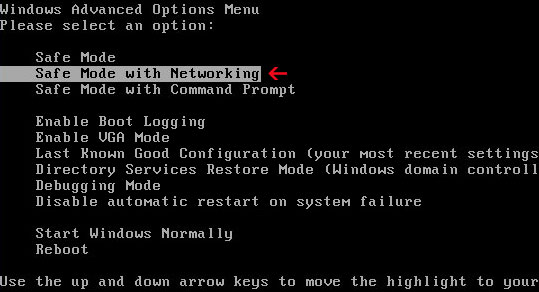

NOTE: Login as the same user you were previously logged in with in the normal Windows mode.

2. Download free anti-malware software from the list below and run a full system scan.
NOTE: in some cases the rogue program may block anti-malware software. Before saving the selected program onto your computer, you may have to rename the installer to iexplore.exe or winlogon.exe With all of these tools, if running Windows 7 or Vista they MUST be run as administrator. Launch the program and follow the prompts. Don't forget to update the installed program before scanning.

3. New threats appear every day. In order to protect your PC from such (new) infections we strongly recommend you to use ESET Smart Security.


Win Defrag associated files and registry values:

Files:
  • %Temp%\[SET OF RANDOM CHARACTERS]
  • %Temp%\[SET OF RANDOM CHARACTERS].exe
  • %Temp%\dfrg
  • %Temp%\dfrgr
  • %Temp%\[SET OF RANDOM CHARACTERS].dll
  • %UserProfile%\Desktop\Win Defrag.lnk
  • %UserProfile%\Start Menu\Programs\Win Defrag\
  • %UserProfile%\Start Menu\Programs\Win Defrag\Win Defrag.lnk
  • %UserProfile%\Start Menu\Programs\Win Defrag\Uninstall Win Defrag.lnk
%Temp% refers to:
C:\Documents and Settings\[UserName]\Local Settings\Temp (in Windows 2000/XP)
C:\Users\[UserName]\AppData\Local\Temp (in Windows Vista & Windows 7)

%UserProfile% refers to:
C:\Documents and Settings\[UserName]\ (in Windows 2000/XP)
C:\Users\[UserName]\ (in Windows Vista & Windows 7)

Registry values:
  • HKEY_CURRENT_USER\Software\Microsoft\Windows\CurrentVersion\Run "[SET OF RANDOM CHARACTERS]"
  • HKEY_CURRENT_USER\Software\Microsoft\Windows\CurrentVersion\Run "[SET OF RANDOM CHARACTERS].exe"
Share this information with other people:

Saturday, November 27, 2010

How to remove Clickpotato adware (Uninstall Guide)

Don't Copy From This Blog...

Protected by Copyscape Plagiarism Detection
Clickpotato is an adware program that may display advertisements and pop-ups on the computer based on your browsing habits. The authors of this will say that their program is not malware, and they have opt outs, clearly written Terms of Use and EULA, uninstallation instructions. That's true. However, we constantly receive complains about PCs being infected with Clickpotato adware. They say that Click Potato starts when computer starts. There are icons on Windows task bar and shortcuts on an Internet Explorer toolbar. Clickpotato may also display an icon on a user's Desktop. Users also say that their programs are freezing and shutting down. And, of course, that they see a constant barrage of non-related advertisements. Without a doubt, that's not what you would expect from such program.

Once installed, ClickPotato can be seen as a shortcut on an Internet Explorer toolbar, as seen in the image below:


ClickPotato may also display an icon on a user's taskbar, as seen in the image below:


Adware.Clickpotato can be downloaded form clickpotato.com or clickpotato.tv.


However, Clickpotato comes bundled with other adware too, e.g. Hotbar, Zango, Adware.FLVPlayer.


Some AV vendors detect Clickpotato as adware: Adware.Clickpotato [Symantec], Pinball [Sunbelt Software], ADSPY/AdSpy.Gen2 [Avira], Adware:Win32/ClickPotato [Microsoft].

You can remove Clickpotato adware manually or using legitimate anti-malware software. Please follow the removal instructions below. Also, don't forget to uninstall add-on from Internet Explorer and Mozilla Firefox (if you have it on your computer). Finally, if you have any questions or additional information about Clickpotato, please leave a comment. Good luck and be safe online!


Scan your computer with recommended anti-malware and clean-up software:

First of all, download recommended anti-malware and clean-up software and run a full system scan to make sure that your computer is not infected with malicious or potentially unwanted applications and that your files are not corrupted before proceeding with the uninstall process.


Clickpotato adware removal instructions:

1. Go to: Start->Control Panel
2. Double click on Add/Remove programs (Programs and Features icon in Windows Vista)
3. In the list of currently installed software find "Clickpotato" and click on Change/Remove (Uninstall in Windows Vista) to uninstall it.
4. Open Internet Explorer. Click on the Tools menu and select Manage Add-ons. The Add-ons window will appear.


Disable/Uninstall all Clickpotato adware Add-ons (if exist).

If you use Mozilla Firefox then click on the Tools menu and select Add-ons. The Add-ons window will appear.


5. Download recommended anti-malware software and run a full system scan to remove the leftovers of this adware from your computer.

It's possible that an infection is blocking anti-malware software from properly installing. Before saving the selected program onto your computer, you may have to rename the installer to iexplore.exe or winlogon.exe. Don't forget to update the installed program before scanning.
    NOTE: With all of these tools, if running Windows 7 or Vista they MUST be run as administrator. Launch the program and follow the prompts. Don't forget to update the installed program before scanning.


    Clickpotato adware associated files and registry values:

    Files:
    • C:\Documents and Settings\All Users\Application Data\ClickPotatoLiteSA\ClickPotatoLiteSA.dat
    • C:\Documents and Settings\All Users\Application Data\ClickPotatoLiteSA\ClickPotatoLiteSAAbout.mht
    • C:\Documents and Settings\All Users\Application Data\ClickPotatoLiteSA\ClickPotatoLiteSAau_update.dat
    • C:\Documents and Settings\All Users\Application Data\ClickPotatoLiteSA\ClickPotatoLiteSAEULA.mht
    • C:\Documents and Settings\All Users\Application Data\ClickPotatoLiteSA\ClickPotatoLiteSA_kyf_update.dat
    • C:\Documents and Settings\All Users\Start Menu\Programs\ClickPotato\About Us.lnk
    • C:\Documents and Settings\All Users\Start Menu\Programs\ClickPotato\ClickPotato Customer Support.lnk
    • C:\Documents and Settings\All Users\Start Menu\Programs\ClickPotato\ClickPotato Uninstall Instructions.lnk
    • %ProgramFiles%\Mozilla Firefox\plugins\npclntax_ClickPotatoLiteSA.dll
    • %ProgramFiles%\ClickPotatoLite\bin\[VERSION NUMBER]\ClickPotatoLiteSA.exe
    • %ProgramFiles%\ClickPotatoLite\bin\[VERSION NUMBER]\ClickPotatoLiteSAAX.dll
    • %ProgramFiles%\ClickPotatoLite\bin\[VERSION NUMBER]\ClickPotatoLiteSABHO.dll
    • %ProgramFiles%\ClickPotatoLite\bin\[VERSION NUMBER]\ClickPotatoLiteSAHook.dll
    • %ProgramFiles%\ClickPotatoLite\bin\[VERSION NUMBER]\ClickPotatoLiteUninstaller.exe
    • %ProgramFiles%\ClickPotatoLite\bin\[VERSION NUMBER]\firefox\extensions\install.rdf
    • %ProgramFiles%\ClickPotatoLite\bin\[VERSION NUMBER]\firefox\extensions\plugins\npclntax_ClickPotatoLiteSA.dll
    %ProgramFiles% refers to: C:\Program Files\

    Registry values:
    • HKEY_LOCAL_MACHINE\SOFTWARE\Mozilla\Firefox\Extensions\"ClickPotatoLite@ClickPotatoLite.com" = "%ProgramFiles%\ClickPotatoLite\bin\[VERSION NUMBER]\firefox\extensions"
    • HKEY_LOCAL_MACHINE\SOFTWARE\Classes\AppID\MenuButtonIE.DLL
    • HKEY_LOCAL_MACHINE\SOFTWARE\Classes\AppID\{11C27351-716B-4052-9361-E3B0A3F8221C}
    • HKEY_LOCAL_MACHINE\SOFTWARE\Classes\CLSID\{1602F07D-8BF3-4c08-BDD6-DDDB1C48AEDC}
    • HKEY_LOCAL_MACHINE\SOFTWARE\Classes\CLSID\{7A3D6D17-9DD5-4C60-8076-D1784DABAF8C}
    • HKEY_LOCAL_MACHINE\SOFTWARE\Classes\CLSID\{AC6D819E-AA8F-4418-A3BB-D165C1B18BB5}
    • HKEY_LOCAL_MACHINE\SOFTWARE\Classes\Interface\{30B15818-E110-4527-9C05-46ACE5A3460D}
    • HKEY_LOCAL_MACHINE\SOFTWARE\Classes\Interface\{419EDA30-6DFF-432C-B534-E15D899ABEE4}
    • HKEY_LOCAL_MACHINE\SOFTWARE\Classes\Interface\{618AAD04-921F-44C2-BE38-C0818AF69861}
    • HKEY_LOCAL_MACHINE\SOFTWARE\Classes\Interface\{B5D2ED96-62F9-4C2C-956D-E425B1F67337}
    • HKEY_LOCAL_MACHINE\SOFTWARE\Classes\Interface\{D3A412E8-1E4B-47D2-9B12-F88291F5AFBB}
    • HKEY_LOCAL_MACHINE\SOFTWARE\Classes\TypeLib\{814BAA91-DC22-4350-87D6-0C86E93F7F08}
    • HKEY_LOCAL_MACHINE\SOFTWARE\Classes\TypeLib\{C55CA95C-324B-451C-B2D2-6E895AA75FEC}
    • HKEY_LOCAL_MACHINE\SOFTWARE\Classes\ClickPotatoLiteAx.Info
    • HKEY_LOCAL_MACHINE\SOFTWARE\Classes\ClickPotatoLiteAx.Info.1
    • HKEY_LOCAL_MACHINE\SOFTWARE\Classes\ClickPotatoLiteAX.UserProfiles
    • HKEY_LOCAL_MACHINE\SOFTWARE\Classes\ClickPotatoLiteAX.UserProfiles.1
    • HKEY_LOCAL_MACHINE\SOFTWARE\Classes\MenuButtonIE.ButtonIE
    • HKEY_LOCAL_MACHINE\SOFTWARE\Classes\MenuButtonIE.ButtonIE.1
    • HKEY_LOCAL_MACHINE\SOFTWARE\Microsoft\Internet Explorer\Extensions\{B58926D6-CFB0-45d2-9C28-4B5A0F0368AE}
    • HKEY_LOCAL_MACHINE\SOFTWARE\Microsoft\Internet Explorer\Low Rights\ElevationPolicy\{A078F691-9C07-4AF2-BF43-35E79EECF8B7}
    • HKEY_LOCAL_MACHINE\SOFTWARE\Microsoft\Windows\CurrentVersion\Ext\PreApproved\{1602F07D-8BF3-4c08-BDD6-DDDB1C48AEDC}
    • HKEY_LOCAL_MACHINE\SOFTWARE\Microsoft\Windows\CurrentVersion\Ext\PreApproved\{69725738-CD68-4f36-8D02-8C43722EE5DA}
    • HKEY_LOCAL_MACHINE\SOFTWARE\Microsoft\Windows\CurrentVersion\Ext\PreApproved\{AC6D819E-AA8F-4418-A3BB-D165C1B18BB5}
    • HKEY_LOCAL_MACHINE\SOFTWARE\Microsoft\Windows\CurrentVersion\Ext\PreApproved\{B58926D6-CFB0-45D2-9C28-4B5A0F0368AE}
    • HKEY_LOCAL_MACHINE\SOFTWARE\Microsoft\Windows\CurrentVersion\Uninstall\ClickPotatoLiteSA
    • HKEY_LOCAL_MACHINE\SOFTWARE\ClickPotatoLite
    • HKEY_CURRENT_USER\Software\clickpotatolitesa
    Share this information with other people:

    Friday, November 26, 2010

    How to remove Win HDD (Uninstall Guide)

    Don't Copy From This Blog...

    Protected by Copyscape Plagiarism Detection
    Win HDD is a fake disk defragmenter and computer diagnostics program that deliberately reports false information and displays bogus errors messages on the computer. The rogue program will state that your computer has some serious problems. It will pretend to scan your hard drive disks, Windows registry and computer memory for errors. Win HDD will state that there are numerous critical errors in Windows registry and that your hard drive is missing or unreadable. What is more, this fake software will block other programs on your computer and won't let you download anything from the Internet. As a typical rogue program it will prompt you to pay for a full version of the program to fix supposedly found system errors. Do not fall victim to this fake program. If your computer is infected with WinHDD then please follow the removal instructions below to remove Win HDD from your computer for free using legitimate anti-malware software for free. You can choose to remove it manually too. Associated Win HDD files are listed below.


    Win HDD is from the same family as HDD Control and HDD Defragmenter. It's promoted mainly through the use of fake online scanners and advertisements. The rogue program may install itself on your computer without your permission and knowledge through the use of trojans and other malicious software. The scammers may also distribute their bogus software on Facebook, Twitter and other social networks. Please do not download or install anything from suspicious websites; otherwise you can end up with a rogue program on your computer.

    While Win HDD is running, it will display fake pop-ups titled "Critical Error!", "System Restore" from your Windows taskbar. The text of some of the fake alerts you will see include:
    Critical Error
    Hard Drive not found. Missing hard drive.
    Critical Error
    RAM memory usage is critically high. RAM memory failure.
    Critical Error
    Windows can't find hard disk space. Hard drive error
    It will block nearly all programs on your computer but if you attempt to run a program enough times it will eventually work. The fake alert that you will see when you attempt run a program are:
    Windows detected a hard drive problem.
    A hard drive error occurred while starting the application.
    Ironically, Win HDD detects the same system errors and issues on different computers. It goes without saying that you should remove this rogue program from your computer as soon as possible. If you have already purchased this bogus program then please contact your credit card provider and dispute the charges. Then please follow Win HDD removal instructions below. If you have any questions or additional information, please leave a comment. Good luck and be safe online!


    Win HDD removal instructions using Process Explorer (in Normal mode):

    1. Download Process Explorer and end Win HDD process:
    • [SET OF RANDOM CHARACTERS].exe, e.g. 1648411579.exe
    2. Download free anti-malware software from the list below and run a full system scan.
    NOTE: in some cases the rogue program may block anti-malware software. Before saving the selected program onto your computer, you may have to rename the installer to iexplore.exe or winlogon.exe With all of these tools, if running Windows 7 or Vista they MUST be run as administrator. Launch the program and follow the prompts. Don't forget to update the installed program before scanning.

    3. New threats appear every day. In order to protect your PC from such (new) infections we strongly recommend you to use ESET Smart Security.


    Win HDD removal instructions (in Safe Mode with Networking):

    1. Reboot your computer is "Safe Mode with Networking". As the computer is booting tap the "F8 key" continuously which should bring up the "Windows Advanced Options Menu" as shown below. Use your arrow keys to move to "Safe Mode with Networking" and press Enter key. Read more detailed instructions here: http://www.computerhope.com/issues/chsafe.htm


    NOTE: Login as the same user you were previously logged in with in the normal Windows mode.

    2. Download free anti-malware software from the list below and run a full system scan.
    NOTE: in some cases the rogue program may block anti-malware software. Before saving the selected program onto your computer, you may have to rename the installer to iexplore.exe or winlogon.exe With all of these tools, if running Windows 7 or Vista they MUST be run as administrator. Launch the program and follow the prompts. Don't forget to update the installed program before scanning.

    3. New threats appear every day. In order to protect your PC from such (new) infections we strongly recommend you to use ESET Smart Security.


    Win HDD associated files and registry values:

    Files:
    • %Temp%\[SET OF RANDOM CHARACTERS]
    • %Temp%\[SET OF RANDOM CHARACTERS].exe
    • %Temp%\dfrg
    • %Temp%\dfrgr
    • %Temp%\[SET OF RANDOM CHARACTERS].dll
    • %UserProfile%\Desktop\HDD Control.lnk
    • %UserProfile%\Start Menu\Programs\Win HDD\
    • %UserProfile%\Start Menu\Programs\Win HDD\Win HDD.lnk
    • %UserProfile%\Start Menu\Programs\Win HDD\Uninstall Win HDD.lnk
    %Temp% refers to:
    C:\Documents and Settings\[UserName]\Local Settings\Temp (in Windows 2000/XP)
    C:\Users\[UserName]\AppData\Local\Temp (in Windows Vista & Windows 7)

    %UserProfile% refers to:
    C:\Documents and Settings\[UserName]\ (in Windows 2000/XP)
    C:\Users\[UserName]\ (in Windows Vista & Windows 7)

    Registry values:
    • HKEY_CURRENT_USER\Software\Microsoft\Windows\CurrentVersion\Run "[SET OF RANDOM CHARACTERS]"
    • HKEY_CURRENT_USER\Software\Microsoft\Windows\CurrentVersion\Run "[SET OF RANDOM CHARACTERS].exe"
    Share this information with other people:

    Wednesday, November 24, 2010

    How to Remove HDD Control (Uninstall Guide)

    Don't Copy From This Blog...

    Protected by Copyscape Plagiarism Detection
    HDD Control is a fake disk defragmenter and computer optimization program that deliberately reports false information about hard drive, RAM and Windows registry errors. It pretends to run a system check and then reports numerous errors. It states that certain errors are critical and should be fixed immediately. In order to fix the errors you need to run the defragmenter. If you use Windows XP or Windows Vista, HDD Control will make your desktop background black. That won't happen if you use Windows 7. Finally, it will state that some problems and system issues can not be fixes unless you purchase this useless software. Please do not fall victim to this scam. If your computer is infected with this rogue program then please follow the removal instructions below to remove HDD Control from your computer for free using legitimate anti-malware programs.

    HDD Control malware is from the same family as Check Disk and Ultra Defragger. Such rogue programs are promoted mostly through the use of trojans, fake online scanners, misleading websites and other malicious software. HDDControl can be also distributed on Facebook, Twitter and other social networks. When the rogue program is running, it will block nearly all programs on your computer and display a fake message with the following text:
    Windows detected a hard drive problem.
    A hard drive error occurred while starting the application.
    However, if you attempt to run a program enough times it will eventually work. HDD Control may hijack your web browser and redirect you to various unrelated websites full of ads or even other malicious software. As a typical scareware, it will display fake alerts and notifications from your Windows taskbar. You may even get a notification that your hard drive is missing. Obviously, that's not true; otherwise your computer wouldn't work at all. The text of some of the alerts you may see include:
    Critical Error!
    Damaged hard drive clusters detected. Private data is at risk.
    Critical Error
    Windows can't find hard disk space. Hard drive error
    Critical Error
    A critical error has occurred while indexing data stored on hard drive. System restart required.
    HDD Control's process is a bunch of numbers, e.g. 1648411579.exe. The rogue program keeps the files in Windows Temp folder. Please see the removal instructions below for more information. It goes without saying that HDD Control is a scam. You should contact your credit card provided and dispute the charges if you have already purchased this useless system defragmenter. Then please get rid of HDD Control as soon as possible. Follow the removal instructions below. If you have any questions or additional information about this malware, please leave a comment. Good luck and be safe online!


    HDD Control removal instructions using Process Explorer (in Normal mode):

    1. Download Process Explorer and end HDD Control process:
    • [SET OF RANDOM CHARACTERS].exe, e.g. 1648411579.exe
    2. Download free anti-malware software from the list below and run a full system scan.
    NOTE: in some cases the rogue program may block anti-malware software. Before saving the selected program onto your computer, you may have to rename the installer to iexplore.exe or winlogon.exe With all of these tools, if running Windows 7 or Vista they MUST be run as administrator. Launch the program and follow the prompts. Don't forget to update the installed program before scanning.

    3. New threats appear every day. In order to protect your PC from such (new) infections we strongly recommend you to use ESET Smart Security.


    HDD Control removal instructions (in Safe Mode with Networking):

    1. Reboot your computer is "Safe Mode with Networking". As the computer is booting tap the "F8 key" continuously which should bring up the "Windows Advanced Options Menu" as shown below. Use your arrow keys to move to "Safe Mode with Networking" and press Enter key. Read more detailed instructions here: http://www.computerhope.com/issues/chsafe.htm


    NOTE: Login as the same user you were previously logged in with in the normal Windows mode.

    2. Download free anti-malware software from the list below and run a full system scan.
    NOTE: in some cases the rogue program may block anti-malware software. Before saving the selected program onto your computer, you may have to rename the installer to iexplore.exe or winlogon.exe With all of these tools, if running Windows 7 or Vista they MUST be run as administrator. Launch the program and follow the prompts. Don't forget to update the installed program before scanning.

    3. New threats appear every day. In order to protect your PC from such (new) infections we strongly recommend you to use ESET Smart Security.


    HDD Control associated files and registry values:

    Files:
    • %Temp%\[SET OF RANDOM CHARACTERS]
    • %Temp%\[SET OF RANDOM CHARACTERS].exe
    • %Temp%\dfrg
    • %Temp%\dfrgr
    • %Temp%\[SET OF RANDOM CHARACTERS].dll
    • %UserProfile%\Desktop\HDD Control.lnk
    • %UserProfile%\Start Menu\Programs\HDD Control\
    • %UserProfile%\Start Menu\Programs\HDD Control\HDD Control.lnk
    • %UserProfile%\Start Menu\Programs\HDD Control\Uninstall HDD Control.lnk
    %Temp% refers to:
    C:\Documents and Settings\[UserName]\Local Settings\Temp (in Windows 2000/XP)
    C:\Users\[UserName]\AppData\Local\Temp (in Windows Vista & Windows 7)

    %UserProfile% refers to:
    C:\Documents and Settings\[UserName]\ (in Windows 2000/XP)
    C:\Users\[UserName]\ (in Windows Vista & Windows 7)

    Registry values:
    • HKEY_CURRENT_USER\Software\Microsoft\Windows\CurrentVersion\Run "[SET OF RANDOM CHARACTERS]"
    • HKEY_CURRENT_USER\Software\Microsoft\Windows\CurrentVersion\Run "[SET OF RANDOM CHARACTERS].exe"
    Share this information with other people:

    Tuesday, November 23, 2010

    How to remove Check Disk (Uninstall Guide)

    Don't Copy From This Blog...

    Protected by Copyscape Plagiarism Detection
    Check Disk is a rogue hard drive disk defragmenter and system optimization program that pretends to scan your hard drive disks, registry and system memory for errors. It reports a variety of bogus errors and displays fake messages to scare you into thinking that your computer has some serious problems. Check Disk blocks other programs on your computer and prompts to pay for a full version of the program to remove non-existent computer errors. Do not purchase this rogue program. If your computer is infected with CheckDisk malware then please follow the removal instructions below.

    A screen shot of Check Disk


    (Thanks to rogueamp)

    Check Disk is promoted through the use of trojans and other malicious software, e.g. fake/infected web pages. The authors of the rogue program may also promote it on Facebook, Twitter and other social networks. Once installed, Check Disk will pretend to scan your computer for errors. The scan won't take long. After the fake scan it will report 11 errors and recommend system defragmentation. In Windows XP and Windows Vista it will display fake safe mode screen if you choose to defragment your hard drive. The rogue program won't display the fake safe mode screen if you use Windows 7. That's probably the main difference. Some of the fake computer errors Check Disk detects:
    Requested registry access is not allowed. Registry defragmentation required
    Read time of hard drive clusters less than 500 ms
    Bad sectors on hard drive or damaged file allocation table
    Drive C initializing error
    Hard drive doesn't respond to system commands
    Data Safety Problem. System integrity is at risk.
    Registry Error - Critical Error
    Furthermore, CheckDisk will block nearly all programs on your computer and display the following error message:
    Windows detected a hard drive problem.
    A hard drive error occurred while starting the application.

    If you attempt to run a program enough times it will eventually work. Last, but least, Check Disk will display fake errors messages and pop ups from your Windows taskbar. The text of some of the alerts you may see include:
    Critical Error!
    Damaged hard drive clusters detected. Private data is at risk.
    Critical Error
    Hard Drive not found. Missing hard drive.
    Critical Error
    RAM memory usage is critically high. RAM memory failure.
    System Restore
    The system has been restored after a critical error. Data integrity and hard drive integrity verification required.
    Check Disk is from the same family as Ultra Defragger and HDD Defragmenter.
    Without a doubt, you can not trust this program. It's a scam. You should contact your credit card provider and dispute the charges or even cancel your credit card if you have already purchased Check Disk. Then please follow the removal instructions below to remove Check Disk and related malware from your computer using legitimate anti-malware software. XyliBox and Siri posted the CheckDisk registration code: 0973467457475070215340537432225. We do not guarantee that it will work, just give it a try. Click on Help & Support button and enter the code. If it works, the rogue program won't block malware removal tools and other programs making the removal procedure a bit easier. If you have any questions or additional information about Check Disk, please leave a comment. Good luck and be safe online!


    Check Disk removal instructions using Process Explorer (in Normal mode):

    1. Download Process Explorer and end Check Disk process:
    • [SET OF RANDOM CHARACTERS].exe
    2. Download free anti-malware software from the list below and run a full system scan.
    NOTE: in some cases the rogue program may block anti-malware software. Before saving the selected program onto your computer, you may have to rename the installer to iexplore.exe or winlogon.exe With all of these tools, if running Windows 7 or Vista they MUST be run as administrator. Launch the program and follow the prompts. Don't forget to update the installed program before scanning.

    3. New threats appear every day. In order to protect your PC from such (new) infections we strongly recommend you to use ESET Smart Security.


    Check Disk removal instructions (in Safe Mode with Networking):

    1. Reboot your computer is "Safe Mode with Networking". As the computer is booting tap the "F8 key" continuously which should bring up the "Windows Advanced Options Menu" as shown below. Use your arrow keys to move to "Safe Mode with Networking" and press Enter key. Read more detailed instructions here: http://www.computerhope.com/issues/chsafe.htm


    NOTE: Login as the same user you were previously logged in with in the normal Windows mode.

    2. Download free anti-malware software from the list below and run a full system scan.
    NOTE: in some cases the rogue program may block anti-malware software. Before saving the selected program onto your computer, you may have to rename the installer to iexplore.exe or winlogon.exe With all of these tools, if running Windows 7 or Vista they MUST be run as administrator. Launch the program and follow the prompts. Don't forget to update the installed program before scanning.

    3. New threats appear every day. In order to protect your PC from such (new) infections we strongly recommend you to use ESET Smart Security.


    Check Disk associated files and registry values:

    Files:
    • %Temp%\[SET OF RANDOM CHARACTERS]
    • %Temp%\[SET OF RANDOM CHARACTERS].exe
    • %Temp%\dfrg
    • %Temp%\dfrgr
    • %Temp%\[SET OF RANDOM CHARACTERS]>.dll
    • %Temp%\tmp2.tmp
    • %UserProfile%\Desktop\Check Disk.lnk
    • %UserProfile%\Start Menu\Programs\Check Disk\
    • %UserProfile%\Start Menu\Programs\Check Disk\Check Disk.lnk
    • %UserProfile%\Start Menu\Programs\Check Disk\Uninstall Check Disk.lnk
    %Temp% refers to:
    C:\Documents and Settings\[UserName]\Local Settings\Temp (in Windows 2000/XP)
    C:\Users\[UserName]\AppData\Local\Temp (in Windows Vista & Windows 7)

    %UserProfile% refers to:
    C:\Documents and Settings\[UserName]\ (in Windows 2000/XP)
    C:\Users\[UserName]\ (in Windows Vista & Windows 7)

    Registry values:
    • HKEY_CURRENT_USER\Software\Microsoft\Windows\CurrentVersion\Run "[SET OF RANDOM CHARACTERS]"
    • HKEY_CURRENT_USER\Software\Microsoft\Windows\CurrentVersion\Run "[SET OF RANDOM CHARACTERS].exe"
    Share this information with other people:

     
    //PART 2